
Breakthrough T1D, Lupus Research Alliance, and National Multiple Sclerosis Society Award Nearly $1M to Fuel Autoimmune Disease Discovery
NEW YORK, Nov. 18, 2026
Press Release Disclaimer: This is a press release distributed through the XPR Media network. It has not been independently verified by our newsroom.

Breakthrough T1D, Lupus Research Alliance, and National Multiple Sclerosis Society Award Nearly $1M to Fuel Autoimmune Disease Discovery
PR Newswire
NEW YORK, Nov. 18, 2026
Research funding will aim to decode understanding across autoimmune diseases
NEW YORK, Nov. 18, 2026 /PRNewswire/ — Today, leading autoimmune disease nonprofits – Breakthrough T1D (formerly JDRF), the Lupus Research Alliance, and the National Multiple Sclerosis Society – announced the latest recipients of the Common Mechanisms in Autoimmunity Insight Award, which supports projects investigating commonalities across autoimmune diseases to further our understanding of how they develop to accelerate potential treatments for multiple diseases.
Autoimmune diseases cause the body to attack its own cells, tissues, and organs, causing inflammation, damage, and loss of function. Roughly 10% of the population will be diagnosed with an autoimmune disease, with an increased likelihood of developing a second. By looking at shared mechanisms across type 1 diabetes (T1D), systemic lupus erythematosus (SLE), and multiple sclerosis (MS), the Common Mechanisms in Autoimmunity program aims to close gaps in understanding across research areas more efficiently and effectively than working independently.
“For people living with autoimmune diseases, time matters,” Maya Bader, PhD, Director of Research at the Lupus Research Alliance, said. “By combining resources and fostering cross-disciplinary collaboration, we are accelerating the path toward overcoming the challenges of developing cures and therapies for several diseases.”
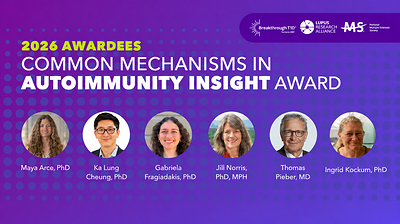
This year, six recipients were selected after a highly rigorous review process and will each receive up to $150,000 to fund a 1-year pilot investigation. Representing leading academic institutions in the U.S. and Europe, the recipients are:
- Maya Arce, PhD, Arc Institute
- Many autoimmune diseases arise from the combined effects of numerous genetic variants, yet most research has examined these variants one at a time, limiting a full understanding of disease risk. Dr. Arce will study how combinations of risk variants interact to disrupt key immune signaling pathways, particularly those controlling CD4+ T cells (a type of immune cell that helps coordinate immune responses and is often improperly activated in autoimmune disease). These findings could help identify more precise treatment targets and match therapies to an individual’s genetic profile.
- Ka Lung Cheung, PhD, Icahn School of Medicine at Mount Sinai
- The Th17 immune pathway plays a central role in many autoimmune diseases, but therapies targeting a single inflammatory molecule have often been ineffective. Dr. Cheung will investigate how Th17 plasticity — the ability of these immune cells to shift and produce multiple inflammatory signals — is controlled, focusing on a key regulator called Hdac7 and testing a targeted inhibitor in models of MS, SLE, and T1D. This work aims to establish a new, more effective therapeutic strategy by targeting the underlying mechanisms of harmful immune activity across a range of conditions.
- Gabriela Fragiadakis, PhD, The Regents of the University of California, San Francisco
- Autoimmune diseases are typically studied as separate conditions, even though they may share underlying immune system dysfunction. Dr. Fragiadakis will combine large-scale single-cell datasets of over a million individual immune cells to identify shared patterns in immune cell behavior and gene activity across these diseases, creating a new framework based on common biological “archetypes” rather than traditional diagnoses. This approach aims to enable more efficient drug development, opening the door to treatments applicable across multiple autoimmune conditions.
- Jill Norris, PhD, MPH, Regents of the University of Colorado
- Autoimmune diseases develop over time through a combination of genetic risk and environmental exposures, often beginning years before symptoms appear. Dr. Norris will explore whether exposure to environmental chemicals such as PFAS, phenols, and phthalates is linked to the onset and progression of SLE, MS, T1D, and rheumatoid arthritis by analyzing samples from individuals at risk before diagnosis. This work aims to uncover preventable environmental drivers of autoimmune disease and enable the development of environmental interventions to reduce the risk of disease development.
- Thomas Pieber, MD, Medical University of Graz – Austria
- SLE, MS, and T1D share some mechanisms but differ in how patients respond to treatment, reflecting gaps in understanding the underlying biology of the diseases. Dr. Pieber will study a key immune signaling pathway, JAK/STAT, by testing how already-approved drugs called JAK inhibitors affect immune cells from patients across these diseases, identifying both shared and disease-specific responses. This study builds on extensive findings from earlier research and aims to accelerate the repurposing of existing drugs and identify the most promising JAK inhibitors for future development.
- Ingrid Kockum, PhD, Karolinska Institutet – Sweden
- While several autoimmune diseases share genetic and biological risk factors, they also differ in how the immune system drives disease. Dr. Kockum will use large-scale genetic, health registry, and lifestyle data, along with advanced analytical and artificial intelligence tools, to identify shared and disease-specific mechanisms, improve early prediction models, and uncover opportunities to repurpose existing drugs. This work aims to enable earlier diagnosis, more targeted prevention strategies, and the development of tailored autoimmune treatments.
“The selected projects represent some of the most promising and rigorous research in the field today, with implications that reach across many autoimmune diseases,” James Quinn, PhD, Director of Biomedical Research at the National MS Society, said. “We’re excited to support work that could redefine therapeutic pathways on a broader scale.”
Since its inception in 2021, the program has awarded 19 pilot investigations in this cross-collaborative effort – reflecting a more unified approach across autoimmune research. As a result of this funding, Aly Khan, PhD, University of Chicago, published a high-profile paper in Nature Biotechnology featuring his project identifying tiny protein fragments – called peptides – that may trigger autoimmune diseases, ultimately working to chart a path toward more personalized and effective treatments.
“This program reflects a forward-looking approach to research – one that prioritizes collaboration, speed, and research excellence,” Joshua Vieth, PhD, Senior Director of Research at Breakthrough T1D, said. “This is how we will drive the next generation of autoimmune disease breakthroughs.”
The Request for Applications (RFA) for the 2027 Common Mechanisms in Autoimmunity Insight Award is now open. Applications are due January 7, 2027. To learn more about the program and selected projects, visit DecodingAutoimmunity.org.
About Breakthrough T1D, Formerly JDRF
As the leading global type 1 diabetes (T1D) research and advocacy organization, Breakthrough T1D (formerly JDRF) helps make everyday life with type 1 diabetes better while driving toward cures. We do this by investing in the most promising research, advocating for progress by working with government to address issues that impact the T1D community, and helping educate and empower individuals facing this condition. Learn more and get involved at X, Facebook, Instagram, and LinkedIn.
About the Lupus Research Alliance
The Lupus Research Alliance is the largest non-governmental, non-profit funder of lupus research worldwide. The organization aims to transform treatment by funding the most innovative lupus research, fostering scientific talent, and driving discovery toward better diagnostics, improved treatments and, ultimately, a cure for lupus. Because the Lupus Research Alliance’s Board of Directors funds all administrative and fundraising costs, 100% of all donations go to support lupus research programs. For more information or to donate to lupus research, visit the LRA at LupusResearch.org and on social media at: X, Facebook, LinkedIn, and Instagram.
About the National Multiple Sclerosis Society
The National MS Society, founded in 1946, is the global leader of a growing movement dedicated to creating a world free of MS. The Society funds cutting-edge research for a cure, drives change through advocacy and provides programs and services to help people affected by MS live their best lives. Connect to learn more and get involved: nationalmssociety.org, Facebook, X (formerly known as Twitter), Instagram, YouTube or 1-800-344-4867.
 View original content to download multimedia:https://www.prnewswire.com/news-releases/breakthrough-t1d-lupus-research-alliance-and-national-multiple-sclerosis-society-award-nearly-1m-to-fuel-autoimmune-disease-discovery-302943096.html
SOURCE Lupus Research Alliance

