Google Workspace Offboarding Template Adds Built-In Vault Export, Removing the Need for Archived User Licenses
New template automates the full user deprovisioning sequence — group removal, Vault export to Cloud Storage, license
Press Release Disclaimer: This is a press release distributed through the XPR Media network. It has not been independently verified by our newsroom.

New template automates the full user deprovisioning sequence — group removal, Vault export to Cloud Storage, license release and account suspension.
DOVER, DE, UNITED STATES, October 13, 2026 /EINPresswire.com/ — Organizations running Google Workspace have long faced a trade-off when employees leave. Deleting a departed user’s account removes their data from Google Vault. Keeping the account preserves the data and continues the license cost — at the full rate while the account is merely suspended, and at the Archived User rate for as long as the retention policy runs.
Most teams choose to keep paying. A new offboarding and deprovisioning template released by Zenphi, an AI workflow building platform, removes the need to choose. The template moves the data out of Vault before the account is deleted, into Google Cloud Storage where it remains retained and retrievable. The account goes. The license obligation ends. The data stays.
What the template automates
The sequence starts wherever offboarding starts in a given organization. The trigger can be an administrator moving a user into a departing-employees organizational unit, a form submission, an event in a connected human resources system, or another workflow in Zenphi or in a different tool handling the offboarding process.
From there it does what offboarding templates generally do: revokes active sessions, resets the password, removes Google Group memberships, releases the license, suspends the account and moves it to a Terminated organizational unit. A tracking table and dashboard record every run, its current step and its outcome.
Zenphi’s template adds a step in between. Before a user is suspended or removed, a full Google Vault or Gmail export can be created, and the searchable data transferred to Google Cloud Storage or an AWS S3 bucket. The aim of that addition is to allow organizations to release Archived User licenses. Deleting an account removes its data from Vault, which is why most organizations keep paying for Archived User licenses rather than risk the loss. Moving the data to designated storage before deletion removes the reason to keep the account at all.
The template ships as a starting point rather than a finished process. On launch, administrators authorize connections to Google Directory, Google Vault, Google Cloud Storage or an AWS S3 bucket, App Licensing and Audit Reports, then configure the individual steps: approval tasks, conditional logic, escalation paths, reminder cadence and who signs off on what.
Retention periods, data recipients and dormant account destinations can differ by role, employment type or business entity — Zenphi does not require users to adopt a template as written, allowing them to adjust it fully to their existing offboarding and retention policies.
The license economics
Why release Archived User licenses rather than keep paying for them? The economics speak for themselves.
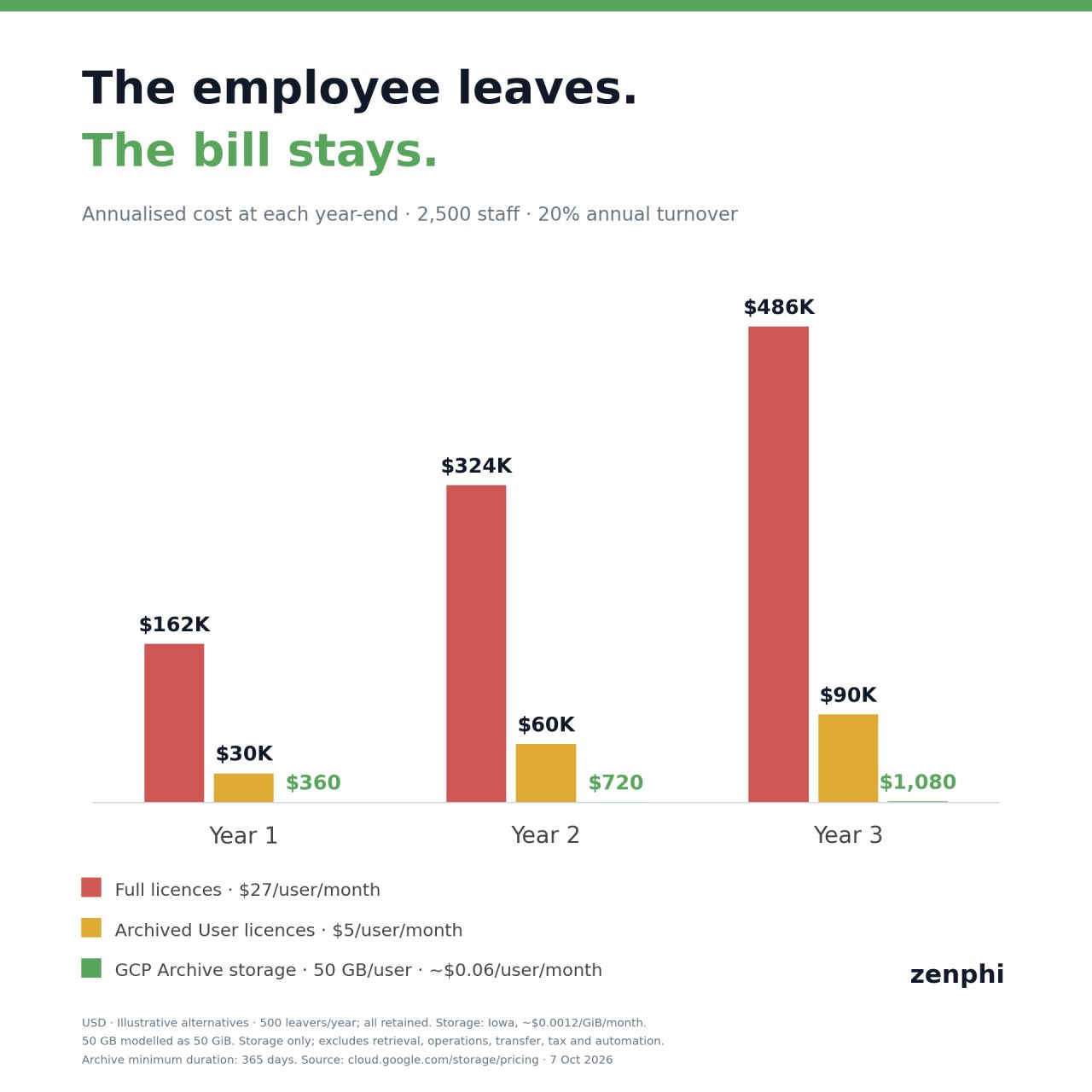
A 2,500-person organization with 20 percent annual turnover produces 500 leavers a year. If none of those accounts are cleared, after three years 1,500 former employees remain on the books. At $27 a month for a full license, the annualized cost reaches $162,000 at the end of year one, $324,000 at year two and $486,000 at year three — $972,000 across the three years. On Archived User licenses at $5 a month, the same accounts cost $30,000, $60,000 and $90,000, or $180,000 in total.
Exporting the same data to archive storage the organization already owns changes the order of magnitude. Modelled at 50 GB per user on Google Cloud Archive storage, the equivalent cost is $360, $720 and $1,080 across the same three years — around $2,160 in total, against $180,000 on Archived User licenses.
That gap is why archived user licenses optimization has become a distinct budget exercise for IT teams managing large tenants, separate from general license management.
“In launching our offboarding template, we were addressing one main challenge: making deletion defensible,” said Vahid Taslimi, CEO and Head of Product at Zenphi. “With this export automation, it is. The export completion is confirmed, the data stays searchable, and every step is logged for audit.”
About Zenphi
Zenphi is a platform used by large and mid-sized businesses worldwide for IT process automation, including user offboarding and deprovisioning, user access reviews, access provisioning, user onboarding and user lifecycle management, as well as building and managing fully governed enterprise AI agents. Zenphi is a Google Cloud Partner, is ISO 27001 certified, HIPAA compliant, GDPR ready and CASA Tier 2 verified, and offers data residency across US, EU and AU regions.
Ana Bibikova
Zenphi
Visit us on social media:
LinkedIn
YouTube
Legal Disclaimer:
EIN Presswire provides this news content “as is” without warranty of any kind. We do not accept any responsibility or liability
for the accuracy, content, images, videos, licenses, completeness, legality, or reliability of the information contained in this
article. If you have any complaints or copyright issues related to this article, kindly contact the author above.

Media gallery